
Introduction
As environmental awareness increases, the sustainability of decking materials has come under greater scrutiny. Selecting a decking material involves balancing durability, maintenance requirements, cost, and environmental impact. As sustainability data and assessment methods continue to develop, these factors are increasingly considered during material selection. This article examines the sustainability of common decking materials by considering environmental footprint, lifecycle impacts, and key trade-offs. The materials discussed include traditional wood, plastic composite decking, aluminium, and mineral-based non-combustible decking systems.
Wooden Decking: The Traditional Choice
Wood has been used for decking for centuries due to its natural appearance, ease of use, and availability. Its sustainability depends heavily on species selection, sourcing practices, treatment methods, and service life.
Environmental impact of harvesting
Sustainability begins with responsible sourcing. Tropical hardwoods such as balau and teak can offer high durability but may be associated with deforestation and biodiversity loss if not responsibly managed. Certification schemes such as FSC can provide assurance that timber is sourced from responsibly managed forests.
Softwoods, including pine and fir, grow more quickly and can be a more resource-efficient option when sustainably sourced. However, their shorter service life may require earlier replacement, affecting long-term sustainability.
Carbon and energy use
Wood stores carbon absorbed during tree growth, and when used in construction this carbon remains sequestered for the duration of the product’s life. This can contribute positively to its overall carbon profile. However, processing, treatment and transportation all contribute embodied energy, which varies depending on sourcing distance and manufacturing efficiency.
Durability and maintenance
Hardwoods can achieve service lives of 25 years or more, provided they are responsibly sourced and properly maintained. Softwoods are generally less durable but may be treated to extend their lifespan. Such treatments often rely on chemical preservatives, which may have environmental and health implications.
End of life
Untreated timber can often be reused, recycled, or biodegrade naturally. Treated timber, however, may require controlled disposal to avoid environmental contamination, reducing end-of-life flexibility.
Plastic Composite Decking
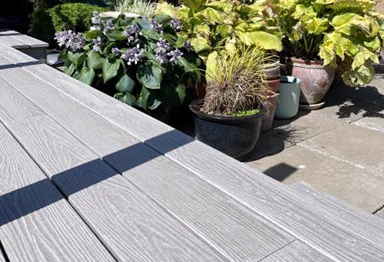
Plastic composite decking, typically made from a blend of recycled plastics and wood fibres, has become popular as a lower-maintenance alternative to timber.
Material composition and sourcing
The use of recycled plastic and wood-processing by-products can reduce demand for virgin materials and divert waste from landfill. This can lower the environmental impact associated with raw material extraction.
Durability and maintenance
Composite decking is resistant to rot, mould, and insect damage and generally requires less ongoing maintenance than timber. It does not require staining or sealing, reducing chemical use over its lifespan. However, some products may be susceptible to warping or deformation under prolonged heat exposure, which can affect long-term performance.
Embodied energy and carbon footprint
Composite decking typically has a higher embodied energy than natural timber due to the energy-intensive production of plastics. Reduced maintenance requirements may partially offset this over the product lifecycle, but outcomes vary depending on formulation, service life, and end-of-life treatment.
End of life and recyclability
Recycling composite decking is more complex than recycling single-material products. While some manufacturers offer recycling schemes, the mixed material composition can limit recyclability, often resulting in landfill disposal at end of life.
Aluminium Decking
Environmental impact of production
Aluminium production is energy-intensive, involving bauxite mining and high-temperature smelting processes. Additional energy is required during extrusion, finishing, and surface treatment. These processes contribute significantly to aluminium’s embodied carbon.
Durability and maintenance
When appropriately detailed and treated, aluminium decking can offer long service life and strong resistance to rot, corrosion, and insect damage. Maintenance requirements are generally low once installed.
Recyclability and end of life
Aluminium is highly recyclable and can be recycled repeatedly without significant loss of material quality. Recycling aluminium requires substantially less energy than primary production, improving its long-term sustainability profile where recycling routes are available.
Mineral-Based Non-Combustible Decking Systems
Environmental impact of production
Mineral-based decking systems are typically manufactured using naturally occurring materials combined with cementitious binders and reinforcing fibres. Production processes may operate at lower temperatures than metal smelting, resulting in reduced process energy requirements. Some systems operate closed-loop manufacturing processes where production offcuts are reused.
Durability and maintenance
Mineral-based non-combustible decking systems are generally highly durable and resistant to rot, moisture, and insect attack. Their long service life can reduce the need for replacement, which may positively influence lifecycle sustainability outcomes.
End of life considerations
Where reuse is possible, extending product life can provide greater sustainability benefits than recycling alone. Some mineral-based systems can be crushed and reused as feedstock in new products or alternative applications, depending on local recycling infrastructure.
Environmental performance data for specific products may be supported by Environmental Product Declarations (EPDs), which provide independently verified lifecycle impact information.
Fire performance and sustainability
Material combustibility can influence sustainability outcomes, particularly in higher-risk buildings. Combustible materials may be subject to removal or replacement following fire risk assessments, increasing material use and waste over the building lifecycle. In this context, non-combustible decking materials may reduce the likelihood of premature replacement driven by fire safety considerations.
Conclusion
No single decking material is universally “most sustainable”. Each option presents a set of trade-offs relating to sourcing, embodied energy, durability, maintenance, fire performance, and end-of-life treatment.
Assessing sustainability requires a lifecycle perspective that considers both immediate environmental impacts and long-term performance. By selecting materials that are responsibly sourced, appropriately durable, and suited to the specific regulatory and environmental context of a project, designers and building owners can support more sustainable construction outcomes.