
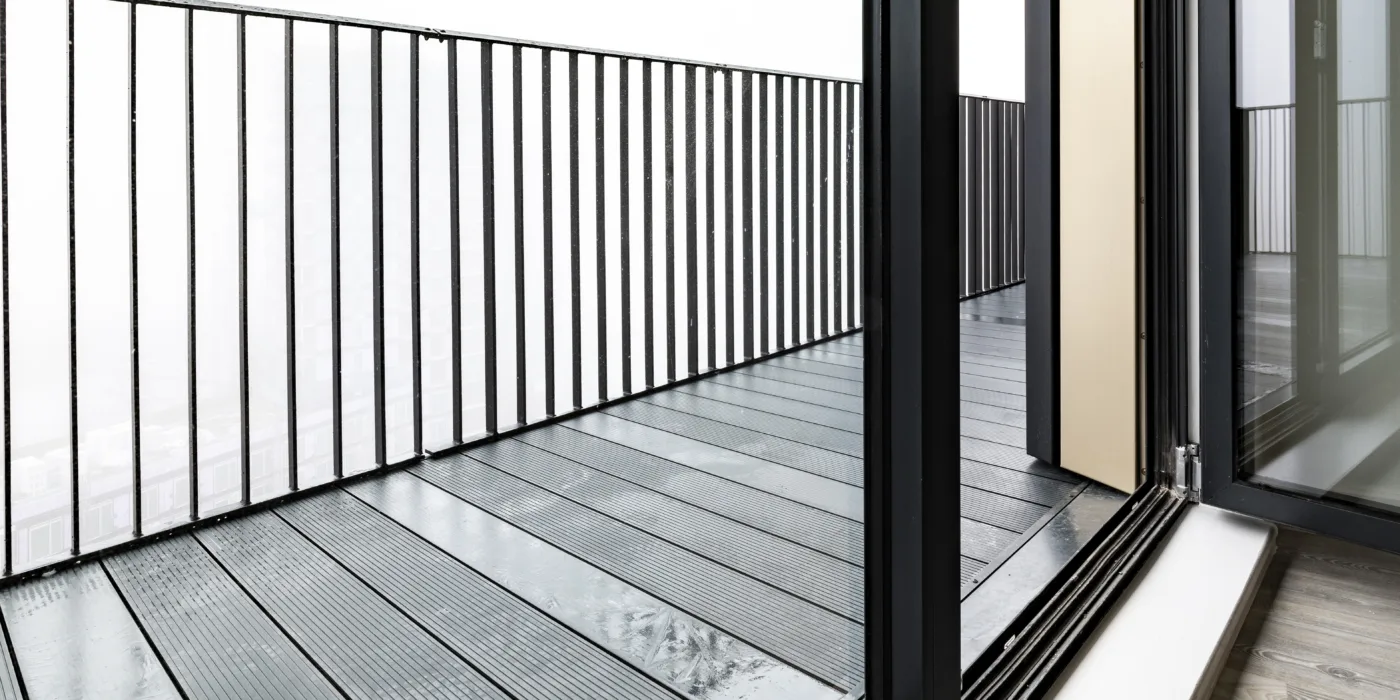
When specifying balcony and terrace decking, project teams must consider fire performance, structural capacity, drainage, durability and appearance. Slip resistance is another important part of this assessment, particularly because external surfaces are routinely exposed to rainwater and contamination.
Selecting suitable decking involves more than finding a product described as “slip resistant”. Specifiers need to understand how the surface was tested, how it performs when wet and whether factors such as gradients, drainage, installation and maintenance could affect performance in use.
Why slip resistance matters
External decking may be exposed to:
- Rain and standing water
- Dirt and construction debris
- Leaves and other organic matter
- Algae or biological growth
- Ice and frost
- Spillages on communal amenity spaces
The level of risk will depend on how the space is used. A private residential balcony may have a different usage profile from a communal roof terrace, access walkway or ramp. Project teams should consider anticipated footfall, exposure and whether the decking forms part of an accessible or principal circulation route.
Slip resistance should therefore be assessed in the context of the intended application, rather than treated as an isolated product characteristic.
Understanding Pendulum Test Values
The pendulum test is a widely recognised method of assessing the slip potential of pedestrian surfaces. It uses a swinging imitation heel fitted with a rubber slider to simulate the interaction between a pedestrian’s heel and the surface.
The friction created as the slider travels across the surface produces a Pendulum Test Value, or PTV. A higher PTV indicates a lower slip potential under the conditions in which the test was conducted.
The Health and Safety Executive commonly interprets PTV results as follows:
| Pendulum Test Value | Slip potential |
| 0-24 | High |
| 25-35 | Moderate |
| 36 or above | Low |
On flat ground, the HSE recommends that flooring surfaces achieve a minimum of 36 PTV in both wet and dry conditions. The BS 7976 series covers the specification, operation and calibration of pendulum testers. The HSE’s guidance on assessing floor slip resistance also provides information on test methods and interpreting test data.
A PTV should always be considered alongside the conditions in which it was obtained. A result from a clean, dry and level sample does not necessarily show how the decking will perform when wet, contaminated or installed on an incline.
The importance of wet test results
External balconies and terraces will regularly be exposed to rain, so dry test results alone do not provide a complete picture of the decking’s likely performance.
When reviewing slip-resistance evidence, project teams should ask:
- Was the product tested in both wet and dry conditions?
- What recognised test method was followed?
- Does the report clearly identify the product and finish?
- Was the product tested in its supplied condition?
- Were several measurements or samples included?
- Was the surface tested in different directions?
Where possible, project teams should review the full test report rather than relying on a single PTV shown on a datasheet. The report should provide context such as the test conditions, surface direction, samples assessed and range of results.
Care is also needed when comparing products. PTV figures are only directly comparable when sufficiently similar test methods and conditions have been used.
Ramps and inclined surfaces
The recommended PTV for flat ground should not automatically be applied to ramps or other sloping pedestrian areas.
As a surface becomes steeper, a greater component of the user’s body weight acts parallel to it. More friction is therefore required to maintain secure footing. A surface that presents a low slip potential on level ground may pose a greater risk when installed on a gradient.
Designers should therefore specify higher PTV values for ramps and sloping areas, taking account of the gradient, likely direction of travel and expected environmental conditions.
This may be relevant where decking forms part of:
- An access ramp
- A sloping walkway
- A change in level between external spaces
- An accessible or principal circulation route
A shallow fall introduced for drainage is not necessarily equivalent to a pedestrian ramp. However, project teams should identify meaningful gradients and assess whether they require greater slip resistance than the minimum recommendation for flat ground.
Surface direction and texture
Many deck boards have directional features such as ribs, grooves or an embossed woodgrain. These can produce different PTV results depending on whether the pendulum travels along, across or at an angle to the surface pattern.
The relevance of this depends on the layout. Movement on a narrow balcony may be mainly in one direction, while users of a large communal terrace could approach the boards from several angles.
Project teams should therefore look for test evidence that reflects the anticipated directions of travel. Where decking is installed on a ramp, board orientation and the direction of travel should be considered together.
It can also be misleading to judge slip resistance by appearance or touch alone. A heavily textured surface may appear to provide more grip, but visual assessment is not a substitute for test evidence. Deep grooves can collect dirt and organic matter, while some coatings may change as they wear.
The chosen surface should combine documented slip resistance with practical cleaning and maintenance requirements.
Drainage and system design
Decking should be assessed as part of the complete balcony or terrace system. A well-tested board cannot compensate for poor drainage or detailing that allows water to collect.
The design team should consider:
- Falls across the balcony or terrace
- The position and capacity of outlets
- Drainage gaps between boards
- Threshold and doorway details
- Channels used to collect or redirect water
- Interfaces with waterproofing systems
- Changes in level that could cause localised ponding
- Access for inspection and maintenance
Effective drainage limits the time water remains on the surface and can help reduce the accumulation of contamination. However, drainage falls and slip resistance need to be coordinated: increasing the gradient also increases the friction required for secure footing.
The drainage strategy, decking layout, support system and waterproofing design should therefore be considered together from an early stage.
Installation and ongoing maintenance
Installation quality can affect the safety of the completed surface. Contractors should follow the manufacturer’s guidance, paying particular attention to:
- Board orientation and spacing
- Secure fixing and adequate support
- Specified falls and finished levels
- Transitions between surfaces
- Prevention of raised edges, rocking or movement
- Protection of the surface during construction
- Removal of debris and residues before handover
Project teams should also confirm that the product supplied to site has the same finish and specification as the product covered by the test evidence.
Slip resistance must then be maintained throughout the decking’s service life. Dirt, leaves, algae and unsuitable cleaning products can all change surface conditions.
The maintenance strategy should include regular inspection, removal of debris and cleaning in accordance with the manufacturer’s instructions. Gaps, channels and outlets should be kept clear, while persistent ponding or biological growth should be investigated.
The required frequency will depend on exposure, footfall and location. Where there are concerns about an installed surface, in-situ pendulum testing can help assess its current condition.
Specifying for real-world performance
Slip resistance cannot be assessed from a product description or a single headline figure alone. Project teams need to consider the quality and relevance of the test evidence, as well as the conditions the decking will encounter once installed.
The supporting information should include:
- Wet and dry PTV results
- Confirmation of the test method
- Results for relevant directions across the surface
- Identification of the board, finish or coating tested
- Confirmation that the tested product represents what will be supplied
- Installation, drainage and maintenance guidance
A minimum of 36 PTV in wet and dry conditions provides an important benchmark for flat ground. However, where decking will be installed on a ramp or another inclined surface, the specified PTV should be appropriate for the gradient. Project teams should also consider how surface direction, drainage, installation and maintenance could affect performance once the decking is in use.
Slip resistance should be reviewed alongside fire classification, structural performance, durability and compatibility with the wider balcony or terrace system. Relevant accessibility requirements, including the guidance within Approved Document M, should also be considered where applicable.
By reviewing both the test evidence and the expected site conditions, project teams can make better-informed specification decisions and reduce the risk of performance gaps later in the project.
MyDek provides technical documentation and project-specific design support to help project teams assess their balcony and terrace decking requirements. Contact our technical team to discuss your project or request the relevant product documentation.