


A roof terrace designed for planting, play and relaxation needs to work just as hard beneath the surface as it does above it. Bringing decking, planters, seating and play areas together raises an important question: how will everything be supported, fixed and coordinated within the available roof build-up?
Artificial grass, rubber crumb play surfaces, planters and fixed furniture can all affect the required build-up, drainage strategy, loading and support arrangement. Coordinating these details early helps the project team establish how the different parts of the terrace will work together.
The decking substructure is an important part of that process. With a suitable support arrangement and project-specific detailing, it can help accommodate changes in level, interfaces between finishes and features that need more than a standard decking installation.
Why consider the terrace substructure early?
Terrace designs often bring together products from several suppliers. The decking, play surface, planters and furniture may each have their own installation requirements, yet they need to fit within a shared layout and available roof build-up.
A common finished level, for example, does not necessarily mean a common support height. Decking boards and a play surface may have different thicknesses and require different supporting layers. The transition between the two surfaces needs to account for those differences.
Loading and anchorage also need early attention. A planter or piece of play equipment may require a different support arrangement from the surrounding pedestrian decking. Its position can therefore influence the substructure layout before installation begins.
Considering these requirements together gives the project team an opportunity to resolve interfaces while the design can still be adjusted, helping to reduce changes on site.
Coordinating decking with other terrace finishes
The starting point is understanding what each part of the terrace needs and how it meets the adjacent area.
Artificial grass and rubber crumb surfaces
Where decking meets artificial grass or a rubber crumb play surface, the design needs to account for the complete build-up beneath each finish.
Questions to resolve include:
- What supporting layers does each surface require?
- How will the finished levels meet?
- What edge support or separation detail is needed?
- How will water drain through or beneath the different areas?
A play surface may also have performance requirements associated with the equipment it serves. These need to be coordinated with the relevant supplier when developing the interface with the decking.
Planters
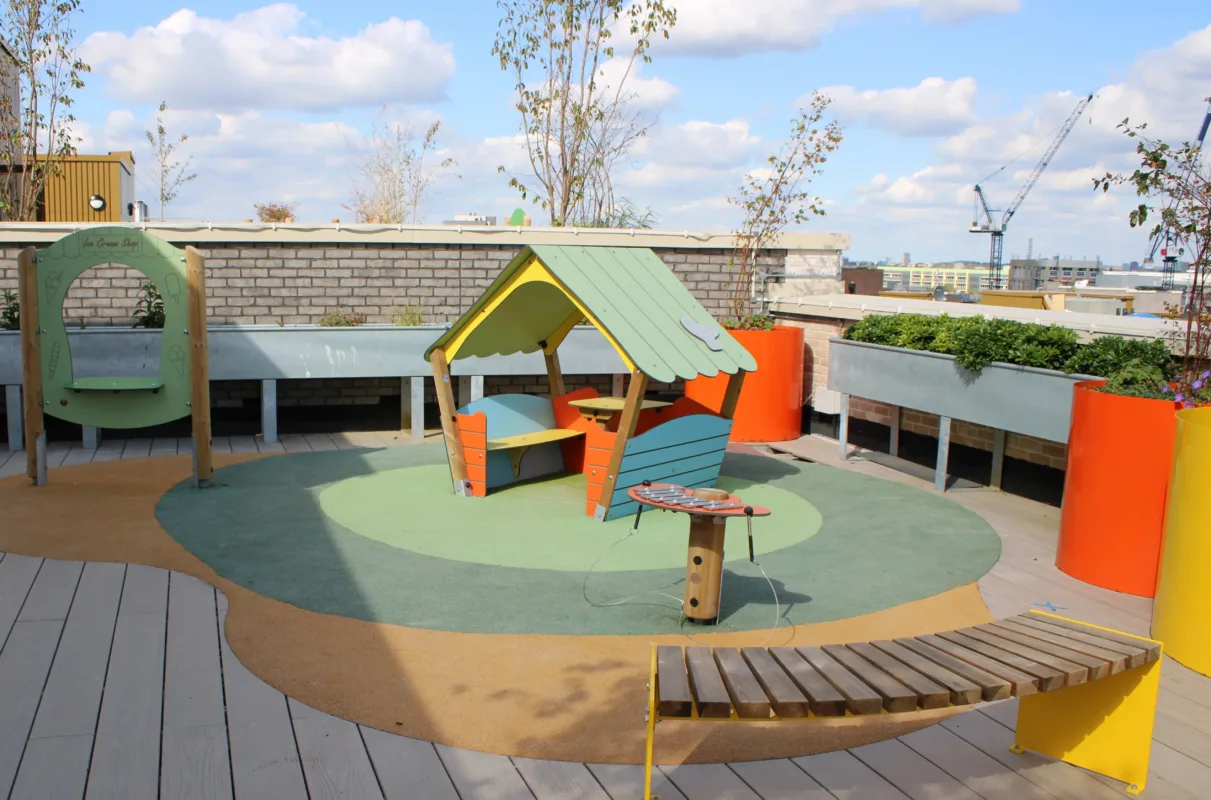
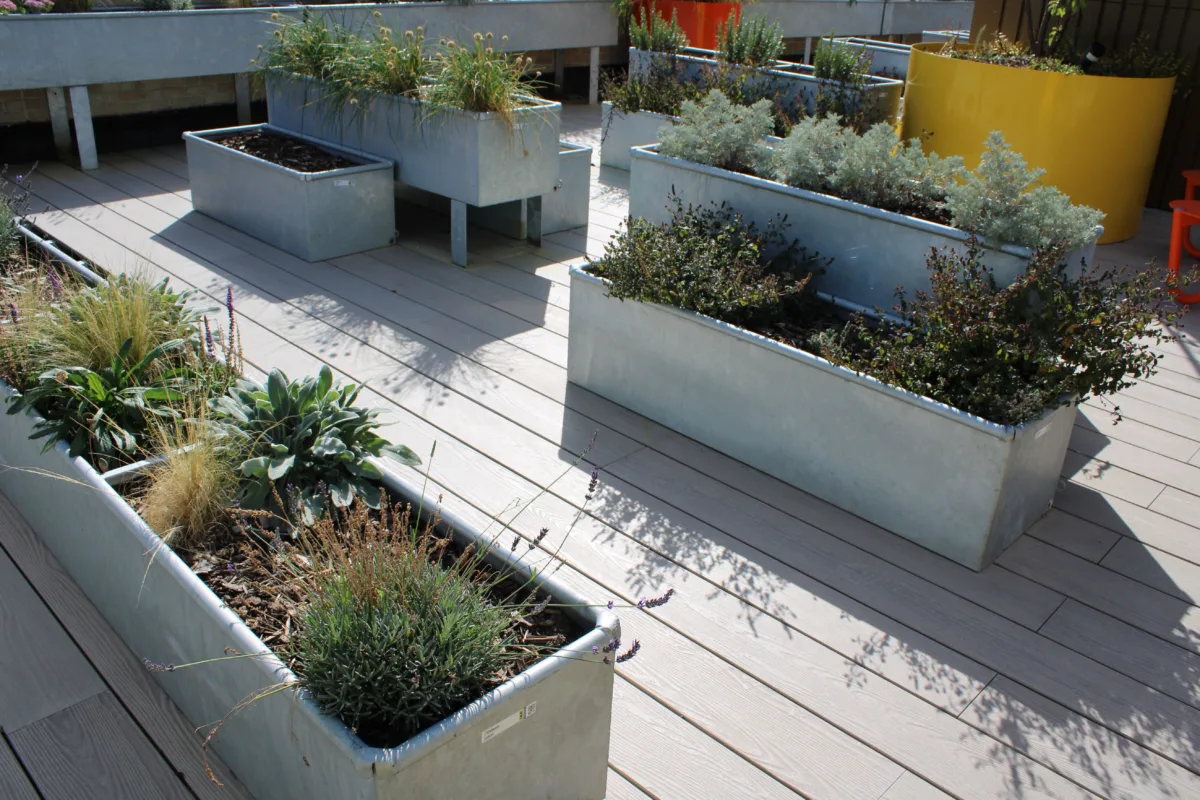
Planters introduce both a layout consideration and a loading requirement. The design needs to account for their filled weight, including growing medium and retained water, and establish how that load reaches the supporting structure.
Their relationship with the decking also matters. Will the decking finish around a separately supported planter, or is a coordinated support detail required? How will drainage outlets and any necessary maintenance access remain accessible?
Resolving these questions early helps establish the decking layout and the support needed around its edges.
Fixed furniture and play equipment
Benches, tables and play equipment may require anchorage as well as support. The appropriate fixing arrangement depends on the item, the forces it introduces and the structure available beneath it.
A fixing position should therefore be considered alongside the substructure layout. Assuming that equipment can simply be attached to the finished deck can leave important questions unresolved until installation.
How BoxRail can help coordinate a complex terrace layout
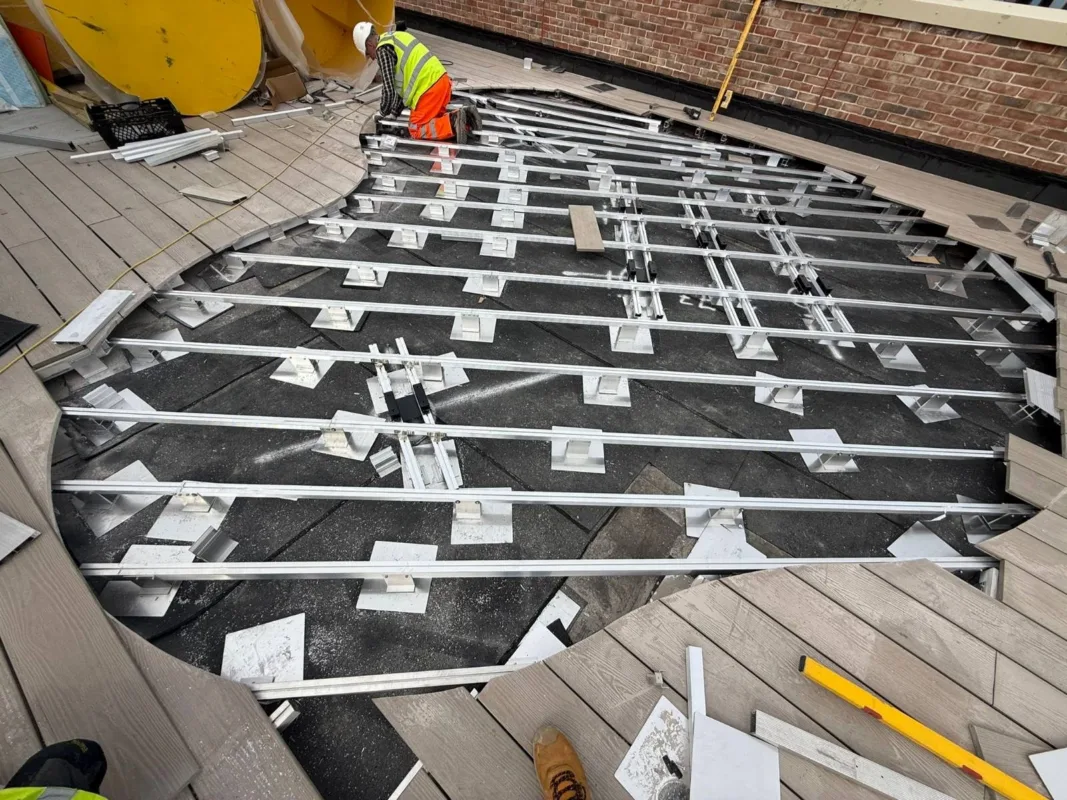
MyDek’s BoxRail and Cleat Support System provides a height-adjustable substructure for balcony and terrace decking. Adjustment at individual support positions allows the decking level to be set above an underlying surface that varies in height, including tapered insulation schemes.
Within a terrace containing several finishes and features, MyDek can explore how BoxRail and compatible substructure components may be incorporated into the wider layout.
This may involve accommodating changes in decking support height, coordinating deck edges with adjacent finishes, or developing bespoke details where standard arrangements are unsuitable.
The appropriate arrangement depends on the application. Coordinating a planter or play surface with BoxRail does not necessarily mean supporting it directly on the decking substructure. Some elements may require independent support, with the decking designed to meet or surround them.
Part of MyDek’s role is to help the project team assess the decking interfaces and identify where a standard component or bespoke detail could address the requirement.
Wickside: integrating playground equipment with BoxRail
At Wickside, MyDek developed bespoke playground anchors to incorporate play equipment within the decking scheme while remaining compatible with the BoxRail substructure.
The project illustrates why the equipment and support arrangement need to be considered together. The terrace had to accommodate the anchorage requirements of the playground apparatus alongside the surrounding decking.
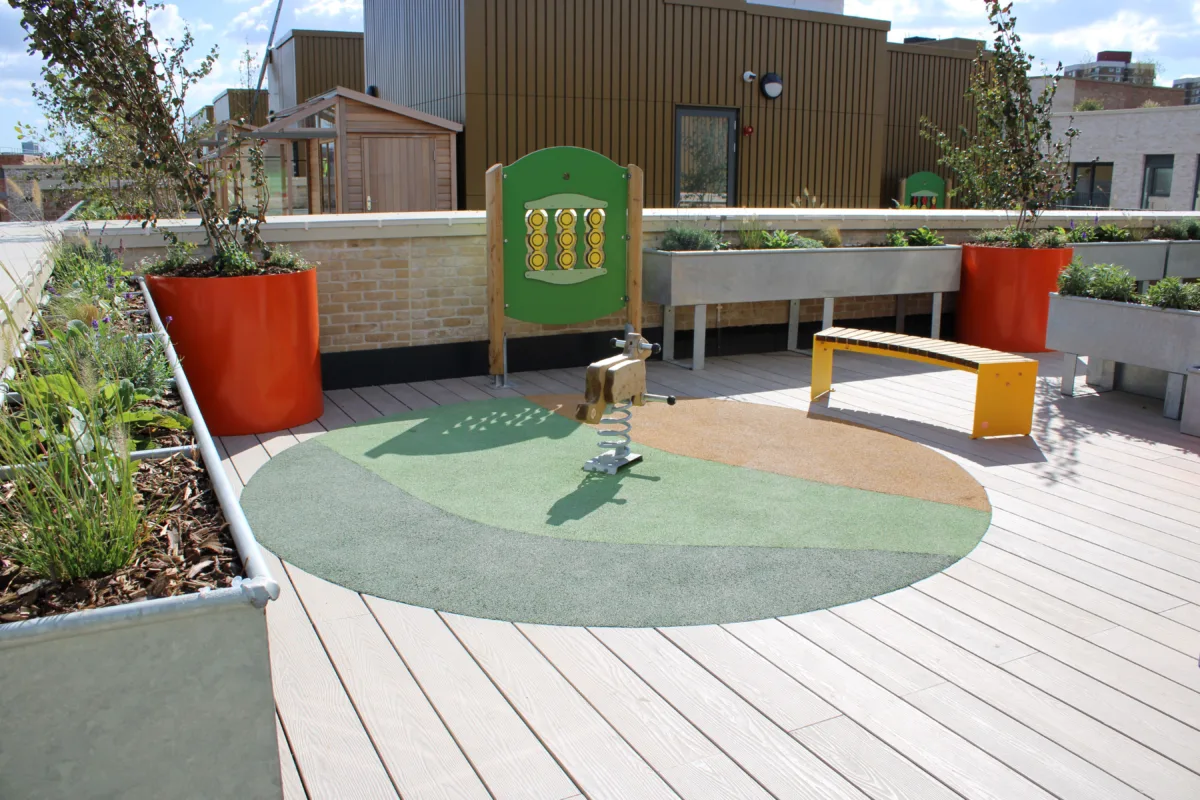
Developing a dedicated detail allowed MyDek to address that interface as part of the scheme. It is a useful example of how project-specific technical input can help resolve requirements that fall outside a standard deck layout.
The same detail will not necessarily suit another project, but the approach is relevant: identify the feature, understand its requirements and coordinate its connection with the supporting arrangement early.
Keeping drainage, waterproofing and loading in view
Every interface needs to be considered within the wider roof terrace design.
Changes in finish, planter positions and equipment supports can affect the space available for drainage and access. Support positions and fixings also need to be coordinated with the roof build-up and waterproofing requirements.
The project team should establish:
- How loads from the different terrace elements will be supported.
- How water will reach the intended outlets.
- How the waterproofing will be protected.
- Where access is needed for inspection and maintenance.
- Which fire and safety requirements apply to the proposed materials and overall arrangement.
Selecting a decking support system is one part of this process. The final design needs to bring together the requirements of the roof, decking, adjacent finishes and installed equipment.
What to share with MyDek at the design stage
A terrace layout is a useful starting point for a technical discussion. To help assess the decking substructure and any unusual interfaces, share:
- The proposed layout, showing decking, other finishes, planters, furniture and play equipment.
- Required finished levels and the available build-up beneath each area.
- Roof build-up and drainage information, including waterproofing details and outlet positions.
- Product and fixing details for features that require support or anchorage.
- Available structural information, including loading limits and any restrictions on support or fixing positions.
Not every detail needs to be finalised before the first conversation. Identifying the outstanding information early can help the team resolve it before installation.
Plan the terrace from the support structure upwards
A successful terrace brings its surfaces, features and supporting construction together. Considering the substructure early helps the project team coordinate levels, resolve junctions and identify where bespoke details may be needed.
MyDek can explore how BoxRail and project-specific components could support the decking design within these more complex layouts, with each arrangement developed around the project’s structural, drainage, waterproofing and safety requirements.
Planning a terrace with mixed finishes or bespoke features? Contact MyDek to discuss your layout, decking substructure and interface details.